China Train Station Guide: Names, Facilities & Transfers
Sources and freshness
Static planning guidance on this page is reviewed by the China Train Tickets editorial team. Train times, fares, seat classes, and availability can change, so the live result for your selected travel date is authoritative.
- Primary operational reference
- China Railway 12306 travel rules FAQ (live results may change when railway operations change)
- Page reviewed
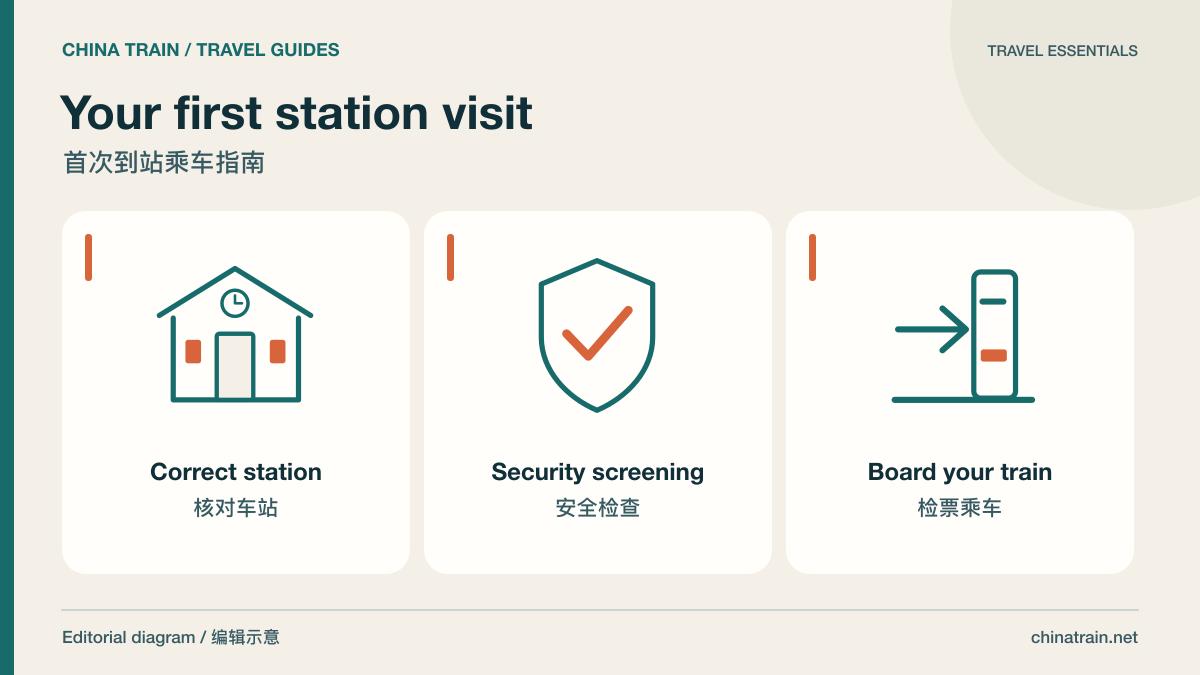
Your first station visit: editorial diagram of key planning topics; not a photograph or official layout.
The first task at a Chinese railway station is to be at the correct station. A city can have several terminals far apart. Once you arrive, separate the journey into station entry, security, the waiting hall, the boarding gate and the platform.
Read the whole station name
Directional words are part of the station name: South is Nan 南, North is Bei 北, East is Dong 东, and West is Xi 西. Beijing South 北京南 and Beijing West 北京西 are different stations. Shanghai Hongqiao 上海虹桥 is different from Shanghai 上海站. Save the exact Chinese station name from the issued itinerary and use it in your map or show it to your driver.
Search results grouped by city may include more than one station. Compare the station-to-hotel transfer as well as the train journey. A slightly faster train may not produce the shortest door-to-door trip.
Allow time from the station entrance to your gate
For a first visit to a large station, planning to reach the railway entrance around 60 minutes before departure is a useful personal buffer, not a nationwide mandatory rule. Allow longer during holidays, with children or heavy bags, or if you need a ticket-counter or accessibility service. Reaching the metro stop or taxi drop-off is not the same as reaching the boarding gate.
Take the original identity document used for booking. For a passport booking, keep that passport ready at entry, boarding and exit checks. An email or itinerary screenshot helps staff find the journey but does not replace the required document. Follow the detailed boarding checklist.
Useful station signs
Scroll sideways to see all columns on smaller screens.
| Chinese | Meaning | What to do |
|---|---|---|
| 进站口 / 安检 | Entrance / security | Prepare your document and baggage for inspection. |
| 候车室 / 候车厅 | Waiting room / hall | Find your train number on the departure display. |
| 检票口 | Ticket-checking / boarding gate | Use the gate shown for your specific train. |
| 站台 / 车厢 | Platform / carriage | Check both numbers before boarding. |
| 出站口 / 便捷换乘 | Exit / convenient transfer | Choose the correct route for leaving or a connecting train. |
Food, luggage and assistance
Large stations often have food outlets, toilets and drinking-water facilities, but smaller stations may have fewer options and opening hours vary. Keep essential food, medicines and charging needs covered without relying on a particular shop. Do not leave your bags unattended or assume every station offers left luggage.
If you need step-free access, a wheelchair or boarding assistance, contact the station or 12306 ahead of travel. Ask staff for the appropriate lift and assistance route; availability and arrangements differ. Keep time for these steps rather than assuming a premium seat provides them.
Connections and arrival transport
Some stations provide a signed internal transfer route. Ask staff whether it is available for your connection before following everyone toward the exit. A change between two stations in the same city requires a separate road or metro transfer plus entry procedures at the next station. Do not treat it as a short platform change.
On arrival, retain your passport for exit checks, then follow signs to the official taxi queue, metro or designated ride-hailing pickup. Check last-service times for a late arrival. See the specific guides for Beijing South and Shanghai Hongqiao.
Sources and current travel checks
Core facts checked on 11 October 2026. Timetables, fares, transport hours and service arrangements should be checked again for your travel date.