China Train Security Rules: Power Banks, Liquids & Sprays
Sources and freshness
Static planning guidance on this page is reviewed by the China Train Tickets editorial team. Train times, fares, seat classes, and availability can change, so the live result for your selected travel date is authoritative.
- Primary operational reference
- China Railway 12306 travel rules FAQ (live results may change when railway operations change)
- Page reviewed
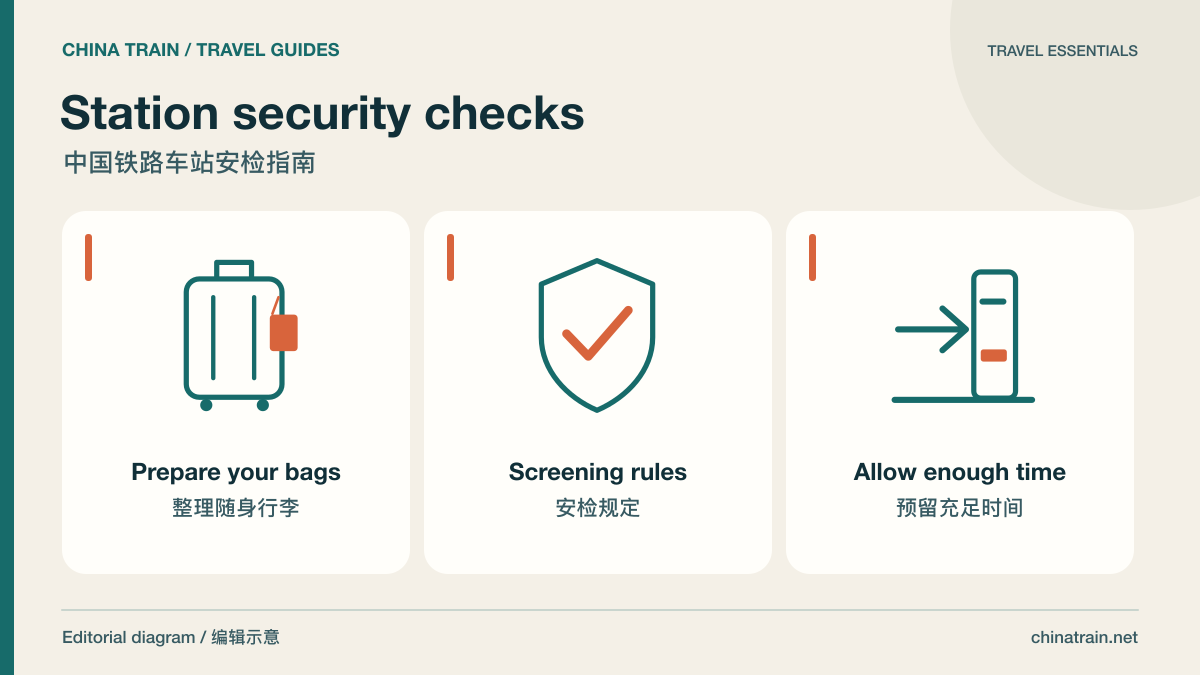
Station security checks: editorial diagram of key planning topics; not a photograph or official layout.
China railway security checks cover passengers and their belongings. The rules are not identical to airport hand-luggage rules: there is no blanket 100 ml limit for every ordinary drink or toiletry. Restrictions depend on the item's contents, packaging and category.
Common restricted items
The following summarizes the National Railway Administration and Ministry of Public Security catalogue in force from 1 July 2022, checked for this guide on 11 October 2026. Special restrictions or station safety directions may also apply.
Scroll sideways to see all columns on smaller screens.
| Item | Published railway limit |
|---|---|
| Power banks and lithium batteries | Clearly marked; rated energy no more than 100 Wh per unit. The catalogue makes an exception for electric wheelchairs containing lithium batteries. |
| Non-pressurized daily-use products containing flammable ingredients, such as some perfumes, sprays or gels | Container capacity no more than 100 ml; one of each type. |
| Pressurized aerosols, such as hair spray or air freshener | Container capacity no more than 150 ml; one of each type and no more than 600 ml combined. |
| Nail polish and nail-polish remover | No more than 50 ml combined. |
| Alcoholic drinks from 24% to 70% ABV, inclusive | Sealed, clearly labeled packaging; no more than 3,000 ml combined. |
For products governed by container capacity, a partly empty oversized container does not meet the capacity limit. Do not transfer products into unmarked bottles to conceal their contents. Alcohol itself, drinks above 70% ABV and alcoholic drinks with unclear labeling fall within prohibited categories; do not assume that a small bottle is acceptable.
Power banks: read the Wh label
Check the manufacturer's printed rated-energy marking before packing. A capacity in mAh alone is not enough to compare products without the rated voltage. For example, 20,000 mAh at 3.7 V equals 74 Wh, but this calculation is not a substitute for a clear product label or the station's inspection. Protect batteries from damage and short circuits; do not carry a damaged or swollen unit.
Knives, tools and dangerous goods
Weapons, explosives, fuels and other dangerous materials are prohibited. Some everyday sharp items and tools are prohibited as carry-on but may be eligible for separate consignment under the catalogue; controlled knives are a different prohibited category. Do not assume a multitool, souvenir blade or camping item is allowed. Check its exact specification with 12306 before travel, and confirm that a suitable consignment service actually exists for your route.
Food, water and medicines
Ordinary drinking water and packaged food are generally possible to take through railway screening, subject to inspection and applicable restrictions. Keep medicines in recognizable packaging and bring supporting information for anything that needs explanation. If you need unusual medical equipment, oxygen or other potentially restricted supplies, ask the railway in advance rather than assuming a medical purpose overrides the rules.
At the checkpoint
Put luggage through the screening equipment, follow the personal-check instructions and collect all belongings. Keep the original booking document accessible for identity checks elsewhere in the station. Allow more time if an item needs examination; do not rely on mailing or storing a refused item at the checkpoint.
These are common examples, not the full prohibited-items list. Read the linked official catalogue for your item and check baggage weight and size rules separately. See the boarding guide for the complete station sequence.
Sources and current travel checks
Core facts checked on 11 October 2026. Timetables, fares, transport hours and service arrangements should be checked again for your travel date.