China High-Speed Train Seat Classes: Second, First & Business
Sources and freshness
Static planning guidance on this page is reviewed by the China Train Tickets editorial team. Train times, fares, seat classes, and availability can change, so the live result for your selected travel date is authoritative.
- Primary operational reference
- China Railway 12306 (live results may change when railway operations change)
- Page reviewed
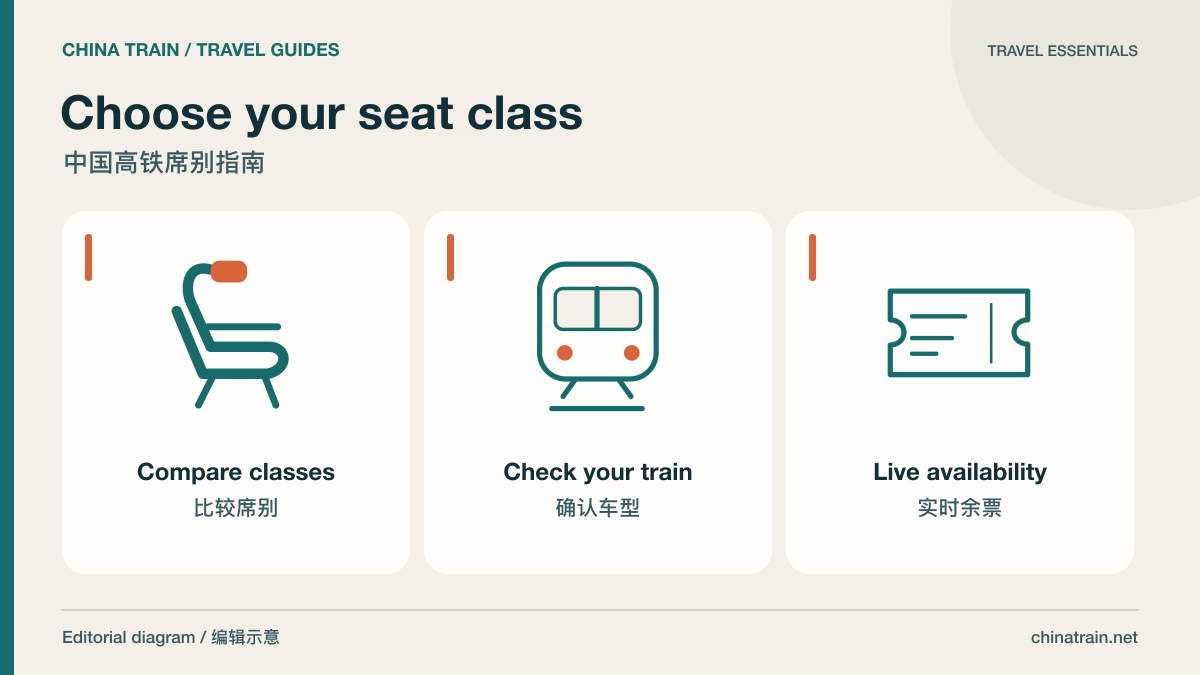
Choose your seat class: editorial diagram of key planning topics; not a photograph or official layout.
For most daytime journeys, second class is the practical starting point. First class offers more space, while business class can suit a longer trip when resting matters more than price. Compare the classes available on your selected train: the train number alone does not guarantee a particular seat or onboard service.
Second class, first class and business class compared
Scroll sideways to see all columns on smaller screens.
| Class | Typical arrangement | When to consider it |
|---|---|---|
| Second class 二等座 | Many standard high-speed trains use 3+2 seating: A, B, C / D, F. | A good starting point for price-conscious travelers and shorter daytime trips. |
| First class 一等座 | Commonly 2+2: A, C / D, F, with no middle seat. | Useful when two travelers want a pair of seats or extra space on a longer ride. |
| Business class 商务座 | Fewer seats and more reclining space; arrangement and seat design vary by train model. | Consider the extra cost if rest or personal space is important. |
These are common configurations, not a promise for every G, D or C service. Some trains offer different premium products, sleeper berths or layouts. A first-class seat is not a sleeper berth, and a business-class ticket does not automatically establish which lounge, meal or transfer services are included.
Which letters are window and aisle seats?
In the standard layouts above, A and F are window positions; C and D are aisle positions; B is the middle seat in the three-seat row. A window position does not guarantee an unobstructed view or a particular direction of travel. Premium cabins and unusual train models may use a different layout, so check the seat plan when one is available.
Seat preference and confirmed allocation are different. Request nearby seats when booking together, then inspect the issued carriage and seat numbers. Do not assume a pair or group will sit together until the actual allocation confirms it.
Read seat numbers: three practical examples
The number identifies the row and the letter identifies the position. Check the carriage as well: the same seat label in a different carriage is a different seat. The examples below apply to the common layouts described above.
Scroll sideways to see all columns on smaller screens.
| Issued labels in the same carriage | What they mean |
|---|---|
| Second class 08D and 08F | The pair on the two-seat side of row 8: D by the aisle, F by the window. There is no E seat between them in this layout. |
| Second class 08A and 08C | Window and aisle seats on the three-seat side. Seat 08B lies between them, so these are not an adjacent pair. |
| First class 08A and 08C | An adjacent pair in the common 2+2 layout: A by the window and C by the aisle. |
For two travelers seeking the standard second-class pair, D and F in the same row are a useful preference when the booking channel supports it. Submit preferences before payment where offered, then verify the final allocation. This guide cannot reserve those seats for you.
How to decide whether an upgrade is useful
- Compare the actual fare difference for the same departure, rather than a fixed percentage: prices vary by train, date and availability.
- For a couple, first class removes the middle-seat issue, but two adjacent second-class seats may already meet your needs.
- For reduced mobility, prioritize a suitable carriage, accessible boarding and staff assistance. Paying for a higher class alone does not arrange assistance.
- For overnight rest, compare an actual sleeper service with a daytime seat. A reclining seat and a reserved berth are different products.
Make the upgrade decision using the actual fare
For a simple comparison, subtract the second-class fare from the first-class fare for the same departure, then multiply the difference by the number of passengers who would upgrade. Compare that extra amount with how much you value the additional space for this journey.
Illustrative arithmetic only: if two displayed fares were CNY 500 and CNY 800 per traveler, the difference would be CNY 300 each, or CNY 600 for two. These invented numbers explain the calculation; they are not current ticket prices or a fare quote for any route. Check actual fares on the Beijing to Shanghai route page or your chosen journey.
Luggage and onboard expectations
You normally carry your bags aboard yourself and use the available racks or designated spaces. A higher seat class does not guarantee storage for oversized luggage or change the railway baggage rules. Keep aisles clear, place heavy bags safely, and keep your passport and valuables with you. Power sockets, Wi-Fi, meals and lounge access depend on the train and service; verify anything essential before paying.
Before confirming your ticket
Check the exact stations, travel date, train number, class, passenger details and total price. For general background, see the China high-speed rail overview. Compare train types, sleeper options and luggage rules before choosing.
Sources and current travel checks
Core facts checked on 11 October 2026. Timetables, fares, transport hours and service arrangements should be checked again for your travel date.
- National Railway Administration: high-speed train seating
- China Railway 12306: tickets and station procedures
Editorial additions reviewed on 18 October 2026. Worked examples explain planning and do not report live fares, inventory or a current train layout.