China Train Types Explained: G, D, C, Z, T and K
Sources and freshness
Static planning guidance on this page is reviewed by the China Train Tickets editorial team. Train times, fares, seat classes, and availability can change, so the live result for your selected travel date is authoritative.
- Primary operational reference
- China Railway 12306 (live results may change when railway operations change)
- Page reviewed
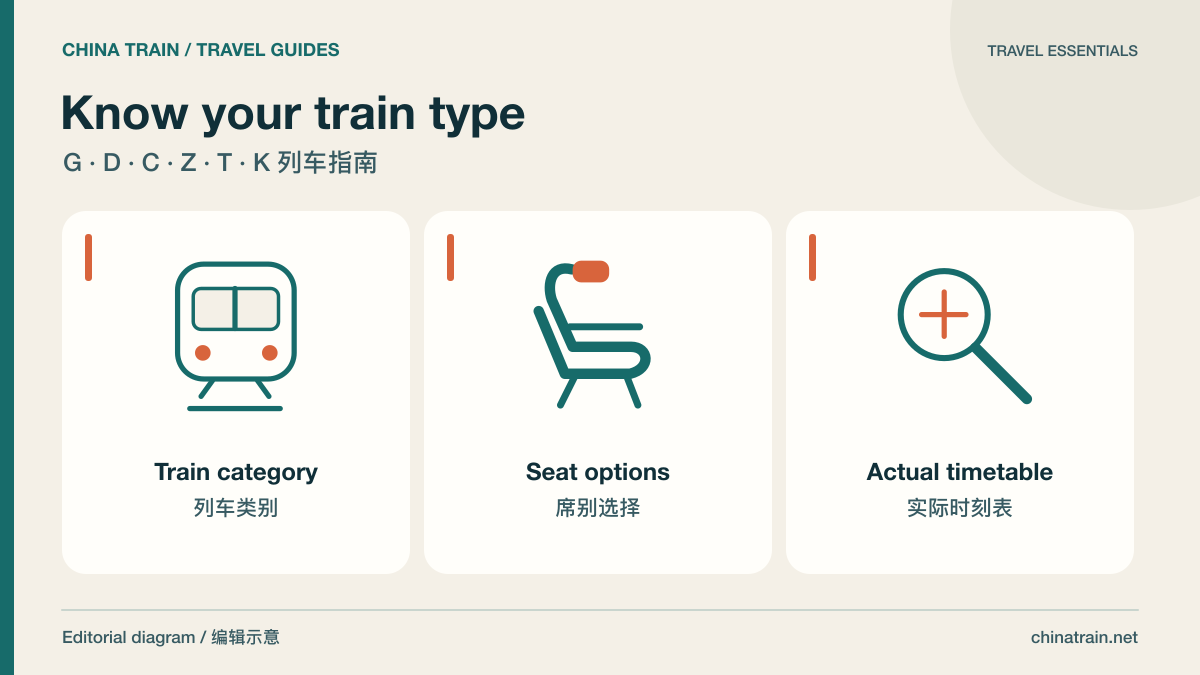
Know your train type: editorial diagram of key planning topics; not a photograph or official layout.
The letter before a Chinese train number identifies a service category. It is a useful starting point, but the actual timetable and seats available are more useful for choosing a journey. Two trains with the same prefix can have different stopping patterns, speeds and facilities.
What the train letters mean
Scroll sideways to see all columns on smaller screens.
| Prefix | Category | What to check |
|---|---|---|
| G | High-speed EMU service 高速动车组 | Actual duration, intermediate stops and available classes. |
| D | EMU service 动车组 | Daytime seats or any offered sleeper products; not every D train is an overnight train. |
| C | Intercity EMU service 城际动车组 | Exact route and station, class and ticket conditions; speed and layout vary. |
| Z | Direct express 直达特快 | Conventional-train seating or berths and actual stops; the name does not guarantee a nonstop journey. |
| T | Express 特快 | Actual travel time, stopping pattern and overnight options. |
| K | Fast service 快速 | Actual duration and available seats or berths, especially for long journeys. |
Other categories exist, including services without one of these prefixes. G, D and C describe train services, not a universal guarantee of a maximum speed, onboard Wi-Fi, food service or a particular seat layout. Do not choose by a speed range copied from an old timetable.
Choose the journey before the letter
- Search your date and compare the full departure and arrival station names.
- Compare the listed travel duration and the time needed to reach each station.
- Check whether the product is a seat, a berth or a no-seat ticket. A train category does not decide this for you.
- Check the arrival day and local transport if the journey crosses midnight.
- Compare the actual fare and conditions for the selected train, rather than assuming one prefix is always cheapest.
When different types can work
For a daytime trip between major cities, start by comparing G and D services, and C services where offered. The fastest listed train may still use a less convenient station. On some long routes, a conventional sleeper can be practical if its departure, arrival and berth suit your plan. On a short journey, a slower service may be entirely reasonable when it leaves from a better-located station.
A confirmed ticket is tied to the specified service and journey. Do not board another departure simply because it has the same letter, destination or fare class. Check change options before traveling if you need a different train.
Compare seats and station arrangements
Use the China high-speed rail overview for network background, the seat-class guide for daytime seating, and the sleeper guide for overnight choices. The station guide explains why exact station names matter.
Sources and current travel checks
Core facts checked on 11 October 2026. Timetables, fares, transport hours and service arrangements should be checked again for your travel date.