China Sleeper Trains: Hard Sleeper, Soft Sleeper & Berth Tips
Sources and freshness
Static planning guidance on this page is reviewed by the China Train Tickets editorial team. Train times, fares, seat classes, and availability can change, so the live result for your selected travel date is authoritative.
- Primary operational reference
- China Railway 12306 (live results may change when railway operations change)
- Page reviewed
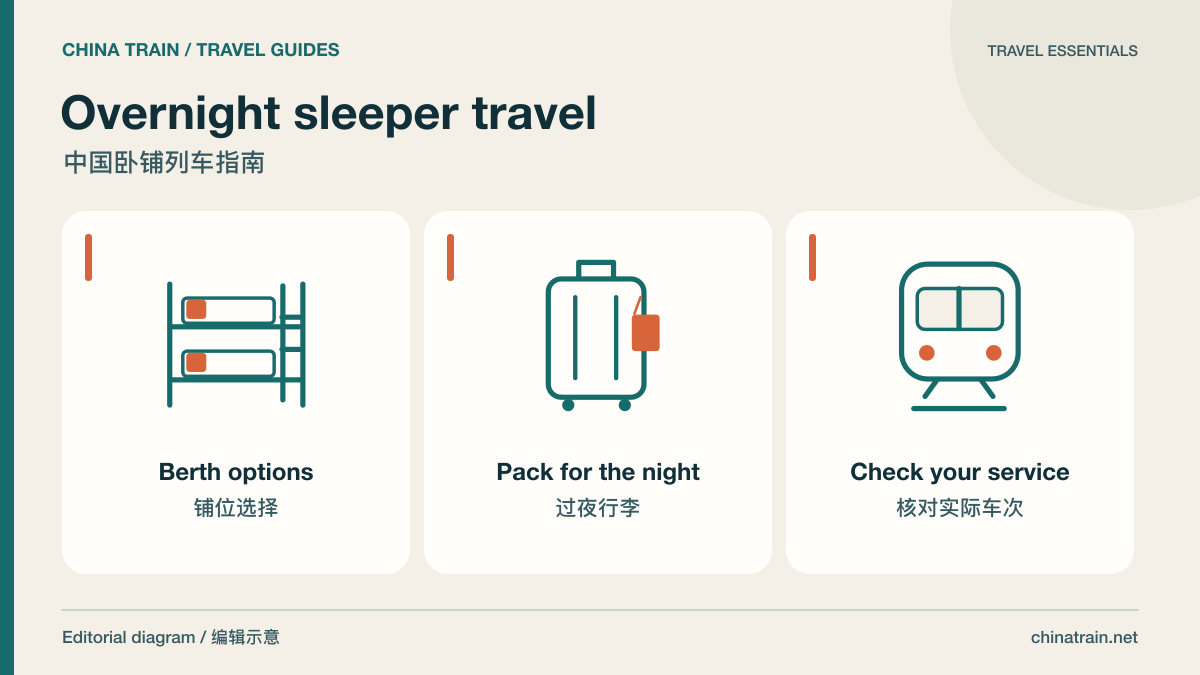
Overnight sleeper travel: editorial diagram of key planning topics; not a photograph or official layout.
A sleeper train can turn a long journey into an overnight trip, but the right choice depends on the berth, departure time and arrival arrangements. Search the actual train and date: not every overnight service has the same sleeper products, and some services operate only on selected days.
Hard sleeper and soft sleeper
Scroll sideways to see all columns on smaller screens.
| Option | Common configuration | Main trade-off |
|---|---|---|
| Hard sleeper 硬卧 | Usually open bays with upper, middle and lower berths, often six berths per bay. | Typically the more economical berth option, with less privacy and more climbing for upper positions. |
| Soft sleeper 软卧 | Commonly an enclosed four-berth compartment with upper and lower berths. | More separation from the corridor, but usually shared with other passengers. |
| Other sleeper products | Some trains offer premium soft sleepers, EMU sleepers or first-/second-class sleepers with different layouts. | Inspect the product shown for the selected train rather than assuming a four-person room. |
Configurations vary. A soft-sleeper ticket generally buys one berth, not exclusive use of a compartment. Do not assume a private bathroom, shower, single-gender compartment or exclusive room unless the specific product confirms it. A seat sold in a sleeper carriage is also not automatically a sleeper ticket: check the purchased class.
Choosing a berth position
Lower berths avoid climbing and may suit travelers with limited mobility. Middle and upper berths require access by steps or a ladder and have different headroom. Consider how often you expect to get up at night, and whether every traveler can safely use their allocated berth.
12306 offers berth selection on eligible services and orders. Availability, the booking channel and the selected product determine what can actually be requested. A preference is not a confirmed lower berth or adjacent compartment until the issued allocation says so. Check the final berth position and fare, especially when comparing a displayed starting price.
Check the date at both ends
An overnight journey may arrive the following day or later. Confirm the departure date at your boarding station, the arrival date, and any late-night check-in arrangements. For a train leaving shortly after midnight, you may need to reach the station the previous evening. An early arrival does not guarantee that your hotel room or onward transport will be available.
Compare the total plan with a daytime train and a hotel night. A sleeper may preserve sightseeing time, but it does not guarantee a full night's sleep; corridor noise, other passengers and intermediate stops can interrupt rest.
What to pack for the night
Keep a small bag with your passport, medicines, phone, charging cable, drinking water, tissues and toiletries within reach. Earplugs and an eye mask may help. Store larger luggage only where the carriage permits, leaving the aisle and exit clear. Keep valuables close and set your own alarm before the destination rather than relying only on a staff reminder.
Toilet style, charging points, bedding and food availability vary by carriage. Bring essential supplies, and do not rely on Wi-Fi or a shower. Before travel, read the luggage guide and security rules.
Before booking
Check stations, operating date, actual sleeper class, berth position, arrival day and cancellation conditions. For a seated alternative, compare high-speed seat classes; for the station sequence, use the boarding guide.
Sources and current travel checks
Core facts checked on 11 October 2026. Timetables, fares, transport hours and service arrangements should be checked again for your travel date.